
Information isn’t the problem. Implementation is.
What you are missing (because it's hard to find in all the noise)

I see you.
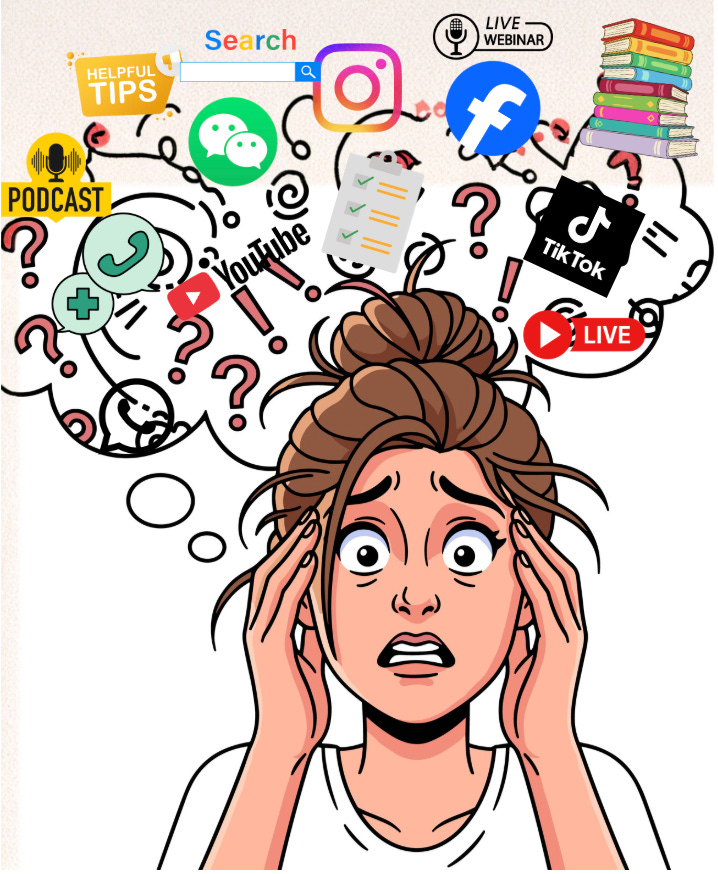
You are trying SO many things to manage ADHD behaviors. And yet things almost feel worse. Not because you aren’t trying hard enough, not because you aren’t learning enough. Not because your kid is un-helpable, worse than others. Not because you aren’t a good enough parent. It’s because change requires more than knowledge.
A reel gives you a dopamine hit but isn’t changing your life. A course is just another unfinished task to beat yourself up about. A book (even mine!) gives you information and insight — but not interruption. Information might be able to explain why your child is melting down over the grilled cheese being too cheesy. It may even be able to tell you what to do. But you probably aren’t going to remember when cheese-gate hits because a 60-second video was never going to rewire how you respond under pressure.
(And the Facebook groups. Oh, the Facebook groups. Thousands of members, a question posted at 10pm out of desperation, and by morning you have 117 responses that all contradict each other and at least 3 people telling you to try magnesium.)
But Don’t Confuse Learning With Doing
Here's what I have witnessed over the past decade of supporting parents of kids with ADHD.
Knowing what to do and doing it are almost completely unrelated — researchers call it the intention-behavior gap, and it's why you can finish the book, agree with every word, and still find yourself reacting the exact same way on Thursday. Your brain rewires from repeated experience.
This is where I am going to shamelessly talk about my weekly support group. Blatantly. Without apology.
Because I have seen firsthand how weekly accountability changes families. A support group doesn’t fix your child. It changes you. And when you change, the whole house shifts. I started a support group over a decade ago because I needed it.
A support group gives you structured learning, rythm that relieves instead of drains.
It gives you improved awareness — not in a theoretical way, but in the “oh… I see what I did there” way.
It gives you a safe place to unravel old stories. The ones about what a “good” child looks like or what a “good” mother should tolerate. The ones you didn’t even know were running the show.
It gives you language. For anxiety. For unmet needs and lagging skills. For nervous system overwhelm.
It gives you a place where the hard thing can be said out loud without someone suggesting a sticker chart.
It gives you accountability that doesn’t shame. Someone asking next week, gently,
“What happened after you sent that email to the school?” and “Now what’s next?”
It gives you perspective when you’ve lost yours. And repetition when you need practice, not inspiration.
If you are thinking, “This sounds helpful… but I’m not sure I can do this right now,”
I want to speak directly to your hesitations:
“I don’t have time.”
Of course you don’t. You’re already holding too much. That’s why this group isn’t another thing to keep up with. You don’t have to attend all the calls. You don’t prepare. You don’t need to engage constantly. You come when you can. You listen when that’s all you have.
Support shouldn’t require more effort — it should reduce it.
When it comes to time, I want to be honest — gently.
Most of us don’t actually need more hours. We need to use one hour differently.
The same hour that disappears into scrolling, zoning out, or another episode when your nervous system is fried.
This isn’t a judgment. Those moments make sense.
This is simply an invitation to ask: What if one of those hours supported you instead of numbing you?
“I can’t spend money at this time.”
If the hesitation is money, let’s talk about that honestly — and without pressure.
Of course this feels hard to spend on. You’ve already spent money on assessments, therapies, tutors, tools, books, programs, and “maybe this will help” solutions.
This isn’t an investment in information. It’s an investment in you — your clarity, your nervous system, and your ability to parent from a place that doesn’t leave you depleted.
And here’s the part no one says out loud: The cost of not having support doesn’t show up as a line item. It shows up as chronic overwhelm, self-doubt, strained relationships, and the quiet belief that you should be handling this better on your own.
Support doesn’t eliminate hard moments. But it dramatically reduces how alone you feel inside them. And that changes everything.
“I’ll fall behind.”
You can’t fall behind here. There are no modules. No replays. No content to catch up on. This group moves at the speed of real life. You arrive where we are — and that’s enough.
“I should wait until things calm down.”
This one is especially understandable. But here’s the hard truth: things rarely calm down on their own. Support isn’t something you earn after surviving the hard parts. It’s what helps you through them. You don’t need to be less overwhelmed to join. You join because you’re overwhelmed.
“I’m not sure I’ll say anything.”
That’s okay. Listening counts. Being present counts. Some parents don’t speak for weeks — and still leave feeling clearer and steadier. There’s no expectation to perform here.
“I should be able to figure this out on my own.”
Many parents of neurodivergent kids believe this — especially the ones who are thoughtful, capable, and used to holding everything together. But this isn’t a personal failing. Parenting neurodivergent kids inside misaligned systems is objectively harder. Needing support doesn’t mean you’re doing something wrong.
It means you’re doing something honest.
I love this quote by Charlie Mackesey.

This group was designed because parents are busy. Because brains are overloaded. Because doing this alone is exhausting. You don’t need more discipline or motivation.
You need containment.
You need clarity.
You need other humans who understand this life.
The doors are open. Join Here.
If it isn’t my group, please find someone who can turn the firehose of information into sips of water for you. One who can alchemize all the latest research into strategies that work for you and your family specifically. Someone who can say, “Yes, this is anxiety.” Or “No, this is skill lag.” Or “You’re in survival mode — pause.”
Discernment is built in conversation, in someone asking better questions. In being gently interrupted when you slide back into old patterns.
Your future self will thank you.